




Music notation you can write in any text editor, read like a lead sheet, keep in version control, and compile to MIDI and audio.
[V1] (Verse - 4 Bars)
Chords: | Am . . . | F . . . | C . . . | G . . . |
Melody: | A4 . C5 E5 | F4 . A4 C5 | E4 . G4 C5 | D4 . F4 B4 |
Lyrics: | the tide  came | in  before  dawn | and  left  a | line  of  salt |
@bass   | a1 . e2 . | f1 . c2 . | c1 . g1 . | g1 . d2 . | vel: 70
That is the whole idea. Four rows that line up, bars separated by |, and a
file any editor, any diff tool and any language model can read.
If you read music but not code, you already understand most of that block — it is a lead sheet with the bars drawn in. Start with Your first song; it assumes nothing about programming and gets you to something you can hear.
If you write code but not music, the thing to know is that you never declare durations. You write how many events happen in a bar and the bar divides itself. Start with the notation reference.
If you are an agent, read AGENTS.md first. It is short, and most of it is the mistakes other agents have already made here.
superinstance.github.io/plainsong — a working compiler in one file: parser, arranger, MIDI writer, a player and three interactive simulations.
It is one HTML file,
so you can also save it and open it from file:// with no server, no build step
and no network. Nothing you type leaves the page.
The simulations are there because two of this system's ideas are hard to believe from prose. One shows a bar subdividing as you change how many events it holds. The other puts four players and a listener on a stage you can drag: move the ear onto the podium and the four sounds land 0 ms apart, move it anywhere else and they do not.
Python 3.10 or newer. Nothing else to install — there are no required dependencies, and that is enforced by CI rather than merely intended.
pip install plainsongNow make a piece and listen to it:
plainsong new "My First Song" -o first.song
plainsong compile first.song -o first.mid --audio first.wav --play
My First Song -- Am, 96 bpm, 4/4
2 sections, dialect: absolute
61 notes across chords (24), melody (22), bass (15)
length 20s
midi first.mid
audio first.wav [builtin/python]
You now have a MIDI file any DAW will open and a WAV you can play anywhere. If
--play says it cannot find an audio player, the files were still written — open
first.wav however you normally would.
Open first.song in your editor. It is a complete, working piece, and it is the
fastest way to learn the format:
**TRACK: My First Song**
[MetaData]
key: Am | tempo: 96 | swing: 0% | subdivision: 8th
time: 4/4 | mood: Open

[V1] (Verse - 4 Bars)
Chords: | Am . . . | F . . . | C . . . | G . . . |
Melody: | A4 . C5 E5 | F4 . A4 C5 | E4 . G4 C5 | D4 . F4 B4 |
Lyrics: | write the words | one bar at a time | the bar divides | itself |
@bass   | a1 . e2 . | f1 . c2 . | c1 . g1 . | g1 . d2 . | vel: 70

[CH] (Chorus - 4 Bars)
Chords: | F . . . | G . . . | Am . . . | Am . . . |
Melody: | F4 . A4 C5 | G4 . B4 D5 | A4 . C5 E5 | A4 . . . |
@bass   | f1 . c2 . | g1 . d2 . | a1 . e2 . | a1 . . . | vel: 74
Change one chord. Recompile. Listen again. That loop is the entire workflow.
The header. **TRACK:** names the piece. [MetaData] sets key, tempo, time
signature and feel. Everything in it has a sensible default, so you can delete
any line you do not care about.
Sections. [V1] (Verse - 4 Bars) opens a section. The tag is yours — V1,
CH, Bridge, Solo. The parenthetical is a comment for humans; the compiler
counts the bars it actually finds.
Rows. A row is a voice. Chords:, Melody: and Lyrics: are built in, and
@anything is a named player — @bass, @piano, @horns. Rows of different
kinds sound together, so the four lines above are one four-bar passage played
by everybody, not sixteen bars in sequence.
Bars and tokens. | separates bars. Inside a bar, tokens are separated by
spaces and . means "no new note here". Pitches are scientific — A4 is A above
middle C, a1 an octave-and-a-bit below.
Options come after the last |: vel: 70 sets velocity for that row.
A bar is one bar long, and the tokens inside it divide it.
Chords: | Am . . . |        four tokens  -> four quarter notes
Melody: | A4 C5 E5 |        three tokens -> a triplet
Melody: | A4 . C5 . E5 . |  six tokens   -> six eighth notes
You do not declare durations. You write how many events happen in the bar and the bar divides itself. Twelve tokens are triplets; a seventeenth cannot spill into the next bar. This is why the lyric row in the starter file says the bar divides itself.
If you want the older fixed-slot behaviour, set core.bar_fill = "grid" — it
will tell you what it had to drop.
Every row divides its own bar, which means two rows can look aligned and not be:
Melody: | A4  .   C5  E5 |     four tokens -> quarters
Lyrics: | the tide came  |     three tokens -> thirds
came is written directly beneath C5 and sounds two thirds of a beat after
it. Ask rather than assume:
plainsong lyrics song.song # which note each syllable really lands onSet core.lyrics = "bound" and each syllable is sung on the note it is written
under, with the barline resyncing so a miscount costs one bar instead of the
rest of the song. The default leaves existing files alone. See
docs/lyrics.md.
[V1] (Verse - 8 Bars)
Melody: | A4 . C5 E5 | F4 . A4 C5 | E4 . G4 C5 | D4 . F4 B4 |
Melody: | C5 . E5 G5 | A4 . C5 E5 | F4 . A4 C5 | E4 . . . |
Two Melody: rows in one section are eight bars of melody, not four bars played
twice. Different kinds stack; the same kind continues.
Everything below works on the file you just made.
Look at it.
plainsong info first.song            # key, tempo, sections, bars, length
plainsong info first.song --verbose  # every diagnostic it can give you
plainsong check first.song           # is anything wrong?
Move it to another key.
plainsong transpose first.song C          # print it
plainsong transpose first.song C -o c.song # write it
plainsong transpose first.song -- -3      # or by semitones
Transposition moves the tonic and keeps the mode, so Am transposed to C is
Cm, not C major. It rewrites the chord row too, which the notation's ancestors
did not.
Add a player. Any @name row becomes its own MIDI track:
@horns | c4-e4-g4 . . . | f4-a4-c5 . . . | vel: 88
Dashes make a chord out of simultaneous pitches.
Change the feel. In [MetaData], swing: 62% gives a jazz eighth-note
feel; time: 3/4 and 6/8 work as you would expect.
Browse the bundled library — several thousand chord charts, across a dozen languages:
plainsong library "waltz"
plainsong play stand-by-meplainsong compile song.song --play # command line
plainsong tui # terminal interface
plainsong serve # web interface at localhost:8765All three drive the same compiler and see the same library and settings. Nothing is available in one and missing from another.
The terminal interface needs Python's curses, which Linux and macOS ship and
stock Python on Windows does not — pip install windows-curses there, or use the
web interface, which needs nothing.
plainsong compile writes MIDI beside your .song file when you pass -o. If
you do not, it writes into the workspace instead, and tells you the full path.
plainsong doctor prints the locations:
config_file   ~/.config/plainsong/config.toml
workspace     ~/.local/share/plainsong/workspace
output_dir    ~/.local/share/plainsong/workspace/output
Nothing is hardcoded and nothing is written outside these unless you ask.
plainsong doctor    # what is installed, and what each missing piece would add
plainsong spec      # verify the system's promises against this machine
There are no required dependencies. The parser, the MIDI writer, the synthesiser, the web interface and every model provider adapter are written against the standard library.
Audio. The built-in synthesiser works with nothing installed. For higher quality, install fluidsynth and a General MIDI soundfont — Plainsong will use them automatically. See docs/audio.md for installation and configuration.
Optional extras — NumPy for faster synthesis, ffmpeg for format conversion, mido for hardware MIDI — are detected when present and never required.
plainsong chart song.song -o chart.svg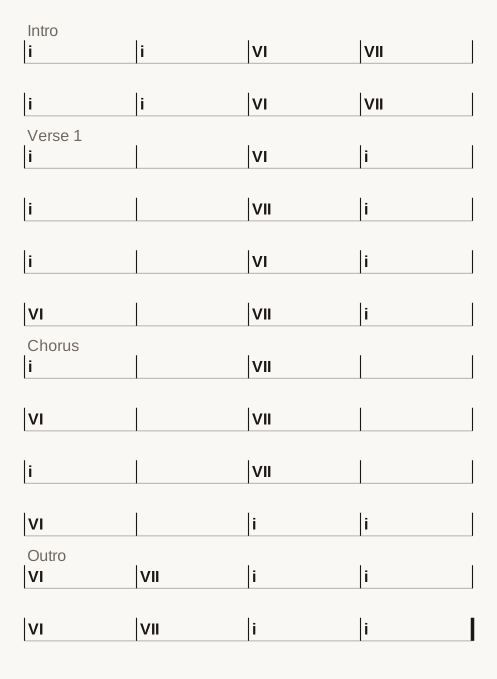
That image is the SVG above, committed to this repository and embedded with an
<img> tag — which is the only way a chart appears in markdown on a platform
you do not control, because GitHub strips a raw <svg>.
Text layout is computed in Python from a shipped width table and then declared
with textLength, so the chart holds its shape on a machine with none of the
fonts it names. Bars are as wide as their contents need, worked out from the
same measurements. It reads prefers-color-scheme, so it is legible in a dark
README as well as a light one.
See docs/chart.md, including what it deliberately is not: a chord chart rather than an engraver, with no noteheads, staff or beaming.
A score usually says "this note is at beat 4.5" without saying where that happens — at the player's hands, at the instrument, or at the ear it is written for. Declare a stage and Plainsong treats written times as arrival times and solves backwards for when each player has to act:
[Stage]
listener: conductor
@timpani: pos 4,-9  | speech: percussion
@organ:   pos 0,-14 | speech: organ-large
$ plainsong stage orchestra.song
  voice    distance  onset   travel  p-centre  act
  timpani  9.8 m     0 ms    29 ms   1 ms      -30 ms
  organ    14.0 m    140 ms  41 ms   60 ms     -241 ms

what conductor hears, against the written beat
  spread 0 ms
The organist's key goes down 241 ms early so the pipe speaks on the beat. At the podium everything lands together; at any player's desk it does not, which is why an orchestra watches rather than listens. See docs/performance.md.
Without a [Stage] block none of this applies and written times are taken at
face value, exactly as before.
The compiler does not need a model. Adding one gives you an agent that writes and revises notation, and a build agent that adapts the install to your setup.
plainsong setup
plainsong agent "a slow waltz in D minor, piano and cello, sixteen bars"
plainsong build            # tailor this install to your machine and use case
It works with hosted APIs (Anthropic, OpenAI, DeepSeek, OpenRouter, Gemini, xAI, Groq, Mistral, Together, Fireworks, Cerebras, Azure), with local servers (Ollama, LM Studio, vLLM, llama.cpp), and with no key at all when you are already running inside another agent such as Claude Code — it borrows the model that is already there. Providers are catalogue entries rather than code, so adding one is a JSON file. See docs/providers.md.
Try it with no key and no network at all:
plainsong agent --provider echo "write something in D minor"plainsong mcp serves the whole system over the Model Context Protocol, so any
MCP-capable client can drive it without shelling out to the CLI.
plainsong mcp                 # JSON-RPC over stdio, what most clients expect
plainsong mcp --http          # loopback HTTP, for remote and multi-agent setups
plainsong mcp --list-tools    # what it exposes
On top of that sits an ensemble session: several agents working on one score at once, each owning a voice. Because the parts are disjoint the common case never conflicts, and a write made against a stale version is refused and handed the current state to rebase onto rather than overwriting somebody.
That half of the system now has a repository of its own, plainsong-mcp, which is where it is developed and where a client should install it from.
compile |
notation to MIDI and audio |
play |
compile and play in one step |
new |
start a piece from a template |
info |
summarise a piece, with every diagnostic under --verbose |
check |
check notation, including examples inside markdown |
chord / voicing |
what a symbol means, and which notes it actually sounds |
chart |
draw a chord chart as SVG, for embedding in a document |
lyrics |
which note each syllable is sung on |
fingerprint |
hash what notation compiles to, so a change in the sound is visible |
transpose |
move a piece to another key or by semitones |
library |
browse the bundled notation |
stage |
what each listener on a stage actually hears |
doctor |
what this machine can do |
spec |
verify the system's promises |
providers / setup |
list and connect model providers |
config |
read and write settings |
agent / build |
the composer and build agents |
serve / tui / mcp |
the web, terminal and protocol interfaces |
bridge |
answer model requests on behalf of a host agent |
Every command takes --json. Use it when parsing output.
Eight complete pieces ship in the repository, written to be read rather than generated. Each one is a template: copy it, change the chords, recompile.
These live in the repository rather than the wheel, so a pip install does not
put them on your disk. Clone, or read them at the links below:
git clone https://github.com/SuperInstance/plainsong
plainsong compile plainsong/examples/plainsong-1-creatures-of-interval.song --audio out.wav
With only pip install, the bundled library is the equivalent — several thousand
charts that are shipped:
plainsong library "waltz"        # search what came with the package
plainsong play stand-by-me # render and play one by name| Creatures of Interval | Four voices, plain 4/4 — the simplest complete piece |
| The Room Is Safe | Lyrics and melody together |
| Hermes Blues | Twelve-bar blues with swing |
| Closing Time | The relative dialect — roman numerals and scale degrees |
| Deck Work | Several named players |
| Spacing: melody · chords · dashes | How duration-by-spacing behaves |
And five deliberately awkward files in
examples/edge-cases/ — polyrhythm, tempo shifts, dense
chords, players with no chord row, and a kitchen sink. They exist to be
compiled, not imitated.
Several thousand more chord charts ship inside the package:
plainsong library "waltz"        # search by title, key or collection
plainsong library --collections  # what is in there
plainsong play stand-by-me       # render and play by name
See the songbook for what is in it and why it is chord charts only.
| For agents | Read this first if you are one. The contract, and the mistakes agents make here |
| Your first song | Thirty minutes from install to a piece you wrote |
| Arranging | Several players, time signatures, and the stage model |
| Integration | Driving Plainsong from other software |
| Getting started | From clone to a finished piece |
| Notation reference | The whole language |
| Performance timing | Stages, arrival times, conductor directives |
| Audio | Rendering to WAV, MP3, and other formats; fluidsynth with soundfonts |
| MCP server | Driving the system from any MCP client |
| Ensemble sessions | Several agents co-authoring one score |
| Providers | Connecting a model, adding your own |
| Host bridge | Running under another agent, with no key |
| Agents | The composer and build agents, and their tools |
| Chords | Which symbols are understood, and the rules that derive the notes |
| Voicing | Which notes sound when a chord names more than fit, and how that was measured |
| Lyrics | Binding syllables to the notes they are sung on, and why padding is not melisma |
| Charts | Drawing a chord chart as SVG, and the measurements behind it |
| The songbook | The bundled charts, and the copyright policy they follow |
| Connectors | Getting notation and audio into other systems |
| Architecture | How it fits together, and why |
| Specs | The checks the system runs against itself |
| Releasing | How a version is cut |
| Contributing | Getting involved |
python3 -m unittest discover -s tests   # the test suite
python3 -m plainsong spec               # the system's checks on itself
python3 -m plainsong check docs examples plainsong/songbook README.md
CI runs all three on Python 3.10 through 3.13 across Linux, macOS and Windows
with nothing installed, which is what keeps the no-dependencies promise honest.
check reads the examples inside markdown as well as .song files, so a snippet
in the documentation that stopped compiling would fail the build.
| Component | Relationship |
|---|---|
| plainsong-mcp | This compiler over the Model Context Protocol, plus the ensemble session several agents share |
| plainsong-worker | Cloudflare Worker version of this compiler — runs Plainsong on the edge |
| fleet-jepa-midi | Takes Plainsong notation as input; JEPA perceives the feel. Its conductor-directive vocabulary is the one plainsong.perform.conduct speaks. |
| fleet-ensemble | Renders Plainsong scores as agentic performances |
Version 1.4. The notation, the CLI surface and the provider catalogue format are stable; changes to them will go through a deprecation cycle.
This release is a rebuild rather than an increment. The previous engine assumed a particular machine — it wrote into a fixed home directory, required numpy, scipy, pretty_midi and flask, and kept several copies of the General MIDI table that had come to disagree with each other. What is here now has no required dependencies, resolves every path at runtime, and treats model providers as catalogue entries rather than code.
What that claim rests on: the suite runs on Python 3.10 through 3.13 across three
operating systems with nothing installed; 6,325 notation sources in this
repository compile; and plainsong spec checks the promises against the machine
in front of you, so you can confirm the above rather than take it on trust.
Known limits, in the open:
- The built-in synthesiser produces mono audio with synthetic timbres. It works immediately with no dependencies. For real instrument samples, install fluidsynth and a soundfont (five minutes on any OS). See docs/audio.md.
- The host bridge cannot stream and reports no token usage.
- The TUI needs
curses, which stock Python on Windows does not ship. - No third-party MCP client has connected to the server yet; its protocol behaviour is verified against the specification instead.
- The bundled songbook (
plainsong/songbook/) is chord charts only — melody and lyric rows were removed from all 6,309 files. A chord progression is not protectable expression; a tune and its words are, and nothing in those generated files recorded provenance. See docs/songbook.md. - The two earlier engines are in
legacy/, unmaintained. Nothing imports them.
MIT. See LICENSE.