Add wallet Sign Message flow for CEX ownership verification#6065
Conversation


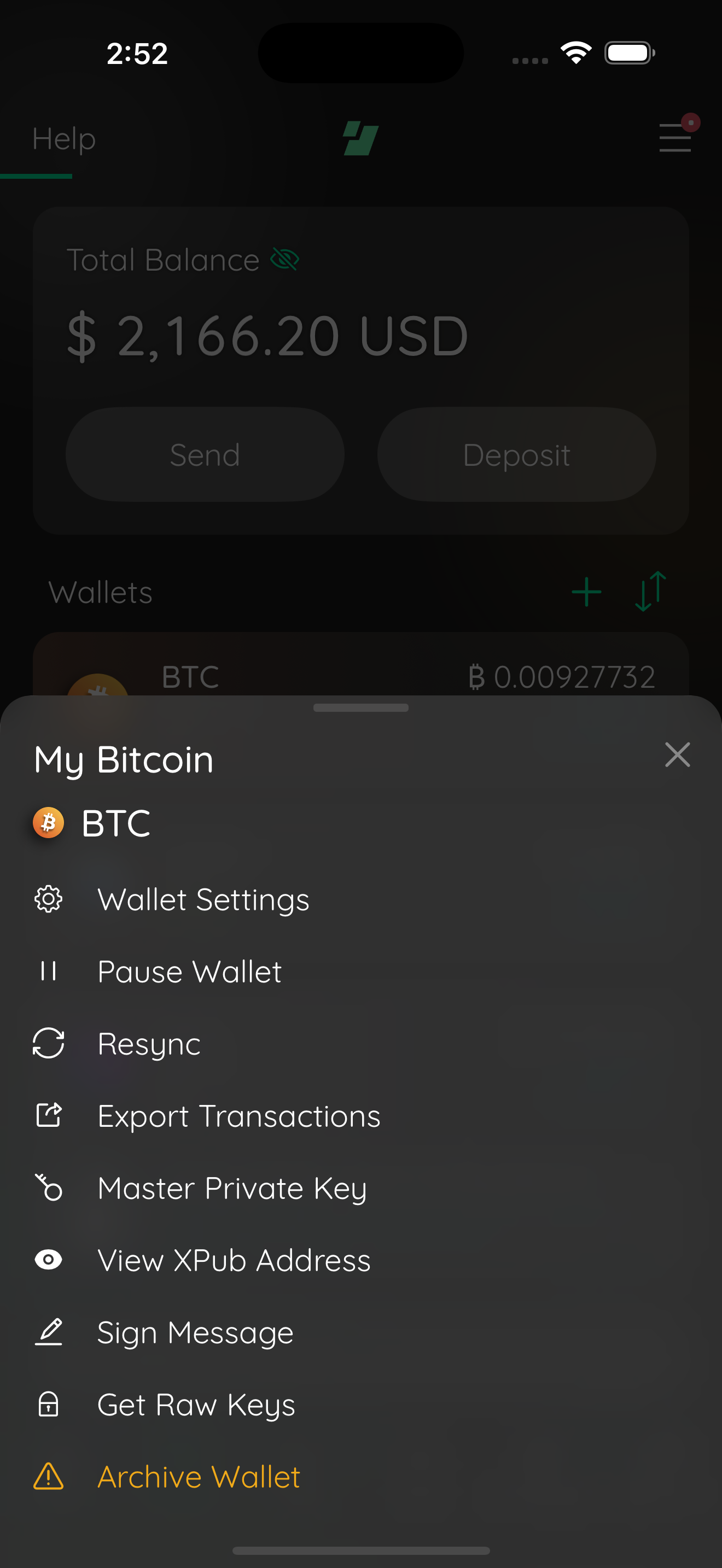
📸 Test evidence (iOS sim)agent proof 1209296431612665 01 wallet menu sign message
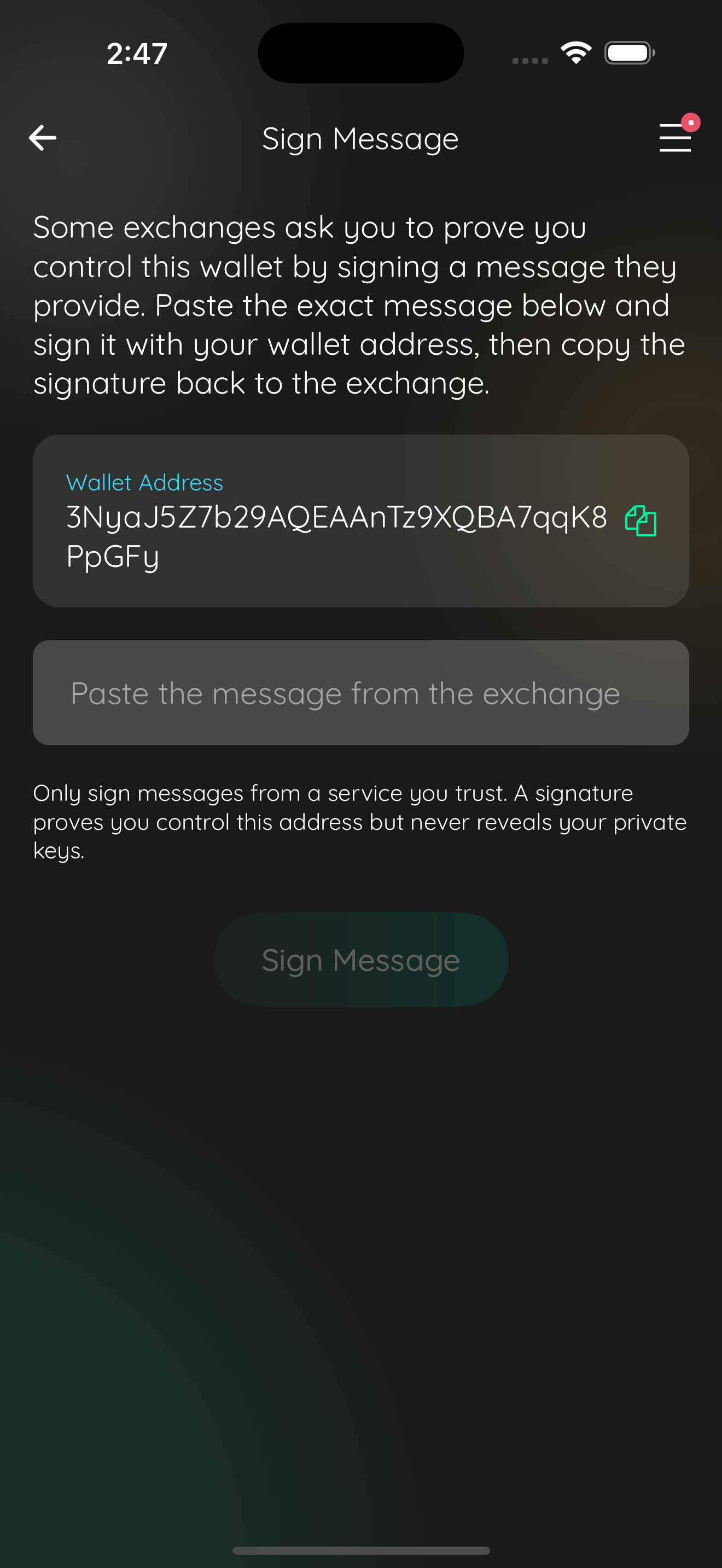
agent proof 1209296431612665 02 sign message scene
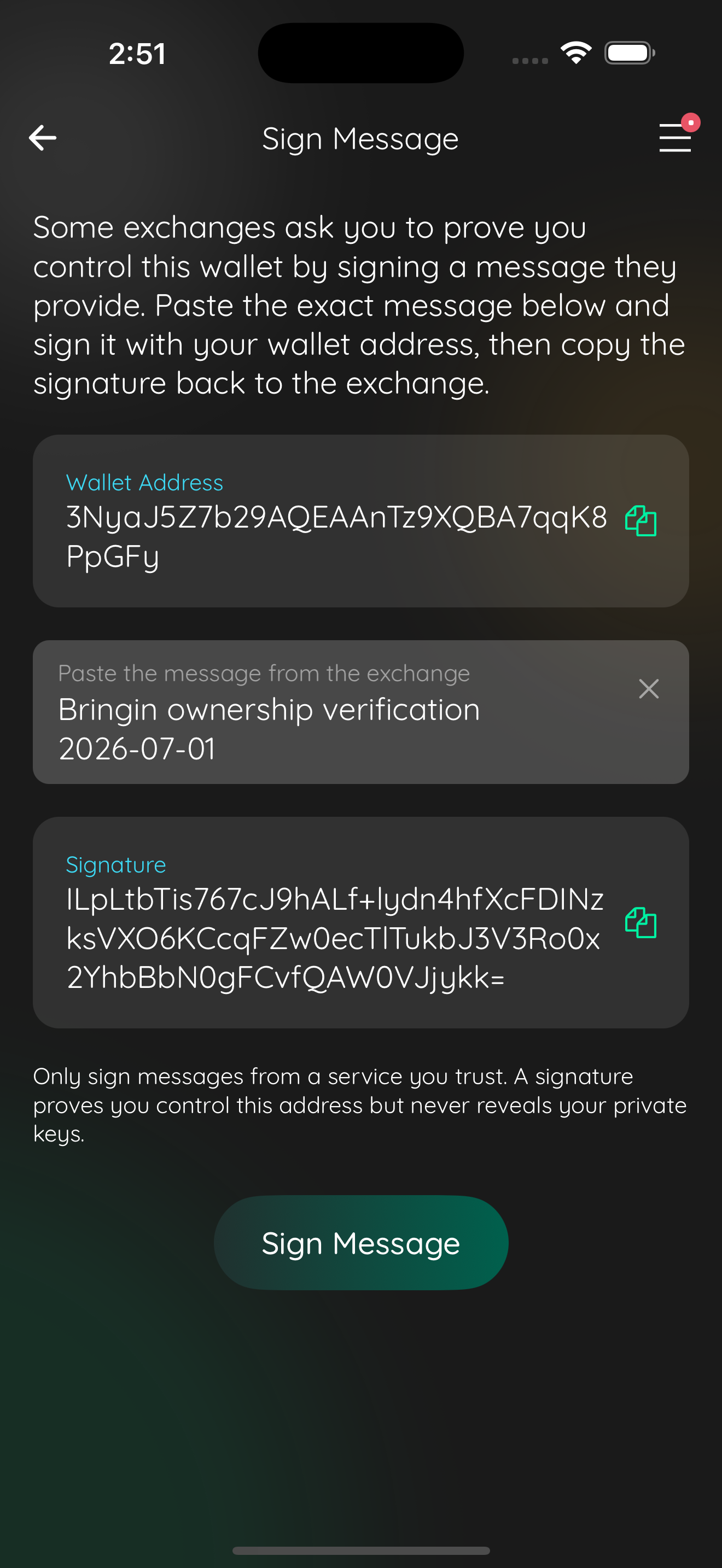
agent proof 1209296431612665 03 signature success
Captured by the agent's in-app test run (build-and-test). |
![cursor[bot]](https://avatars.githubusercontent.com/in/1210556?s=60&v=4)
 j0ntz
force-pushed
the
jon/sign-message-cex
branch
from
j0ntz
force-pushed
the
jon/sign-message-cex
branch
from
97138ed to
7624da7
Compare
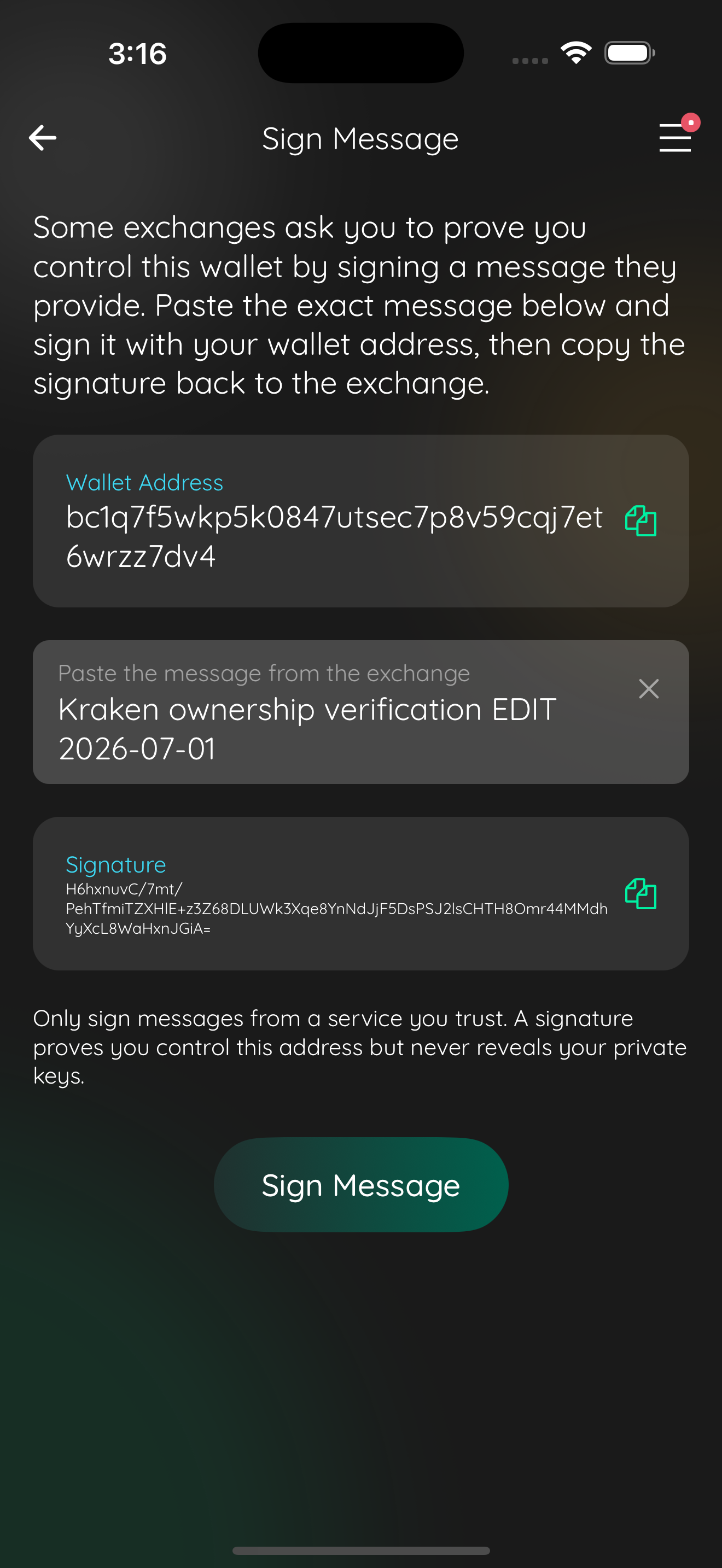
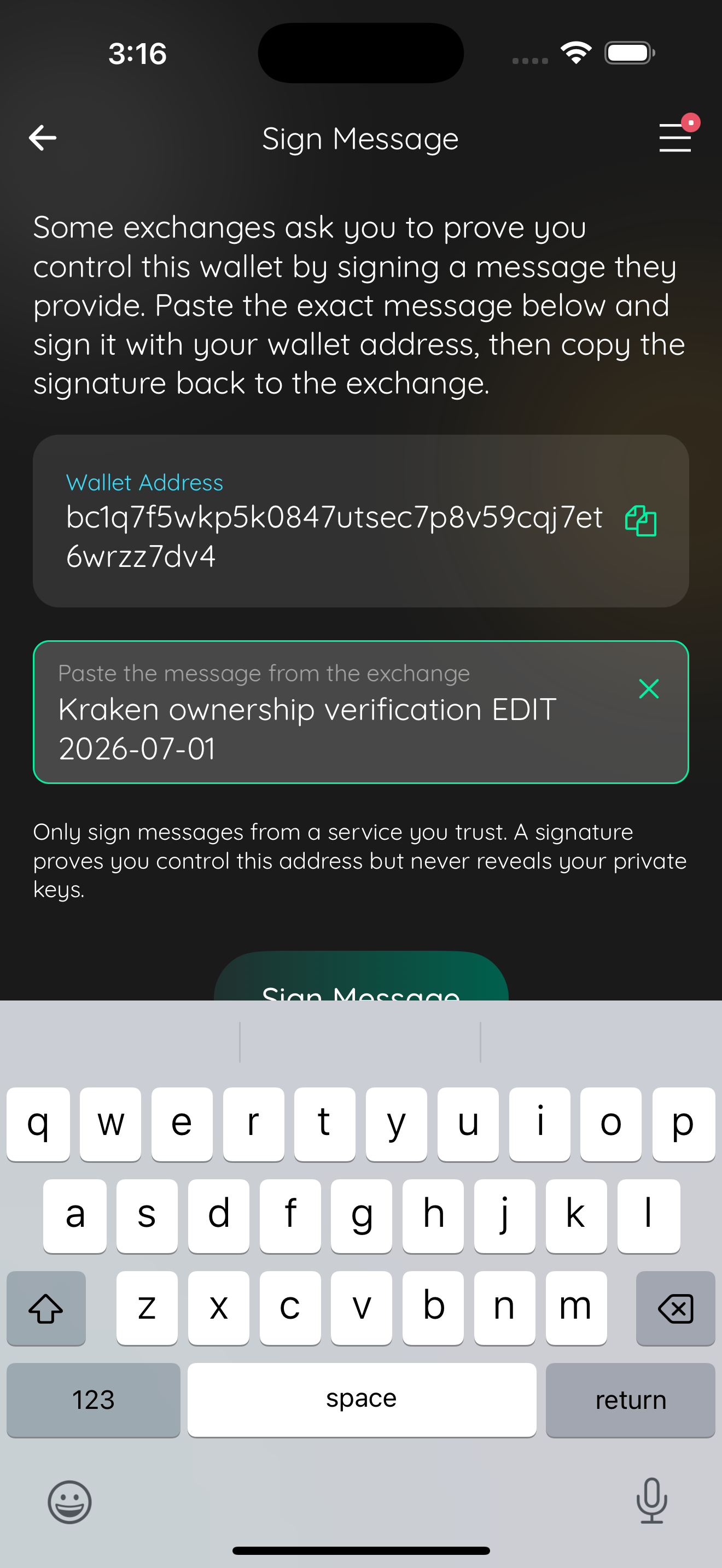
📸 Test evidence (after bugbot fixes)agent proof 1209296431612665 04 segwit signature success
agent proof 1209296431612665 05 signature cleared on edit
Captured by the agent's in-app test run (build-and-test). |

There was a problem hiding this comment.
Cursor Bugbot has reviewed your changes and found 1 potential issue.

❌ Bugbot Autofix is OFF. To automatically fix reported issues with cloud agents, enable autofix in the Cursor dashboard.
Reviewed by Cursor Bugbot for commit 7624da7. Configure here.

Adds a Sign Message option to the wallet list menu for Bitcoin-family
(UTXO) wallets. The new scene shows the wallet's receive address, lets
the user paste an exchange-provided message, signs it with the wallet
key, and returns a copyable signature. This lets users prove control of
a self-hosted wallet for CEX/CASP withdrawal checks (EU Travel Rule)
without manual ID/selfie verification.
Add signMessageInput and signMessageButton testIDs to the Sign Message
scene so UI automation can drive the message field and sign action by a
stable selector.
j0ntz
force-pushed
the
jon/sign-message-cex
branch
from
7624da7 to
d59ad8d
Compare
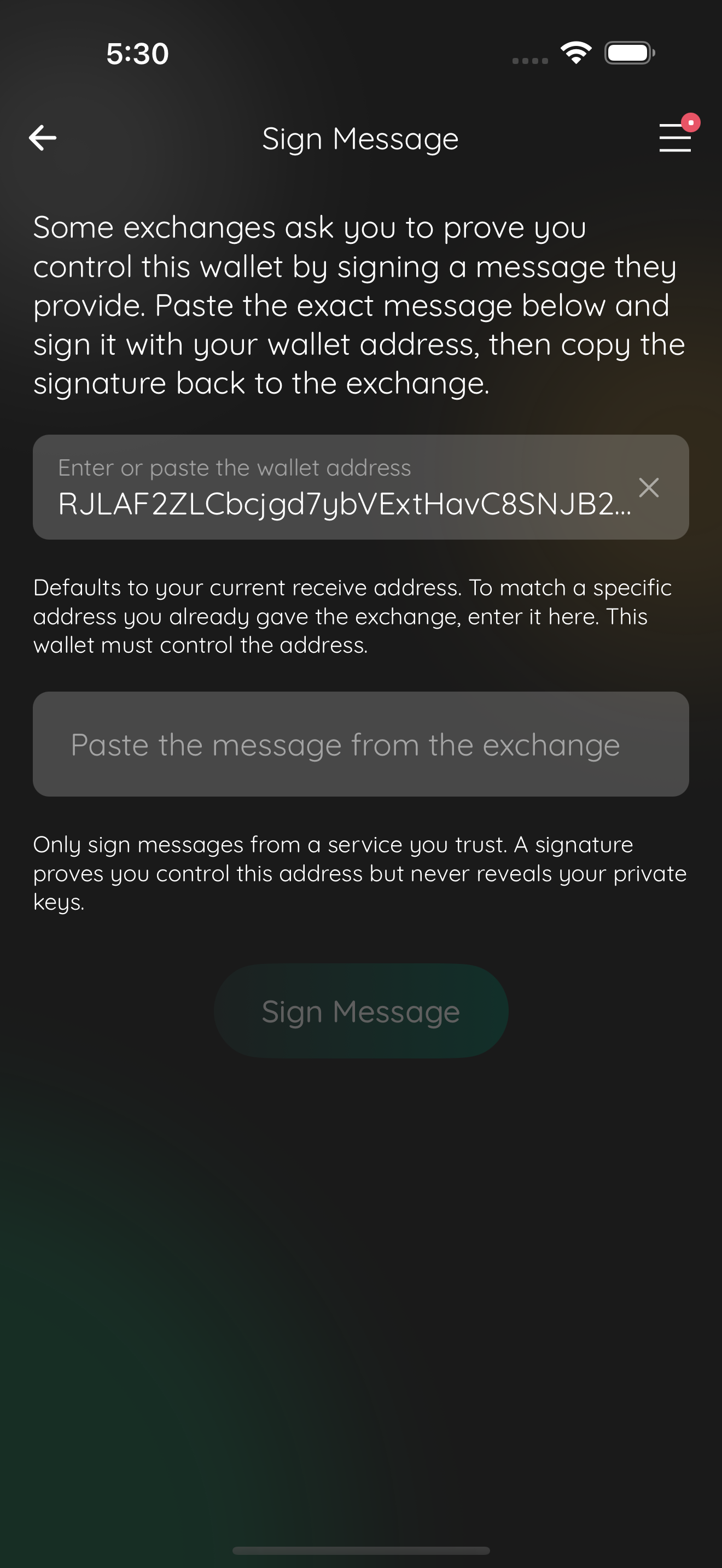
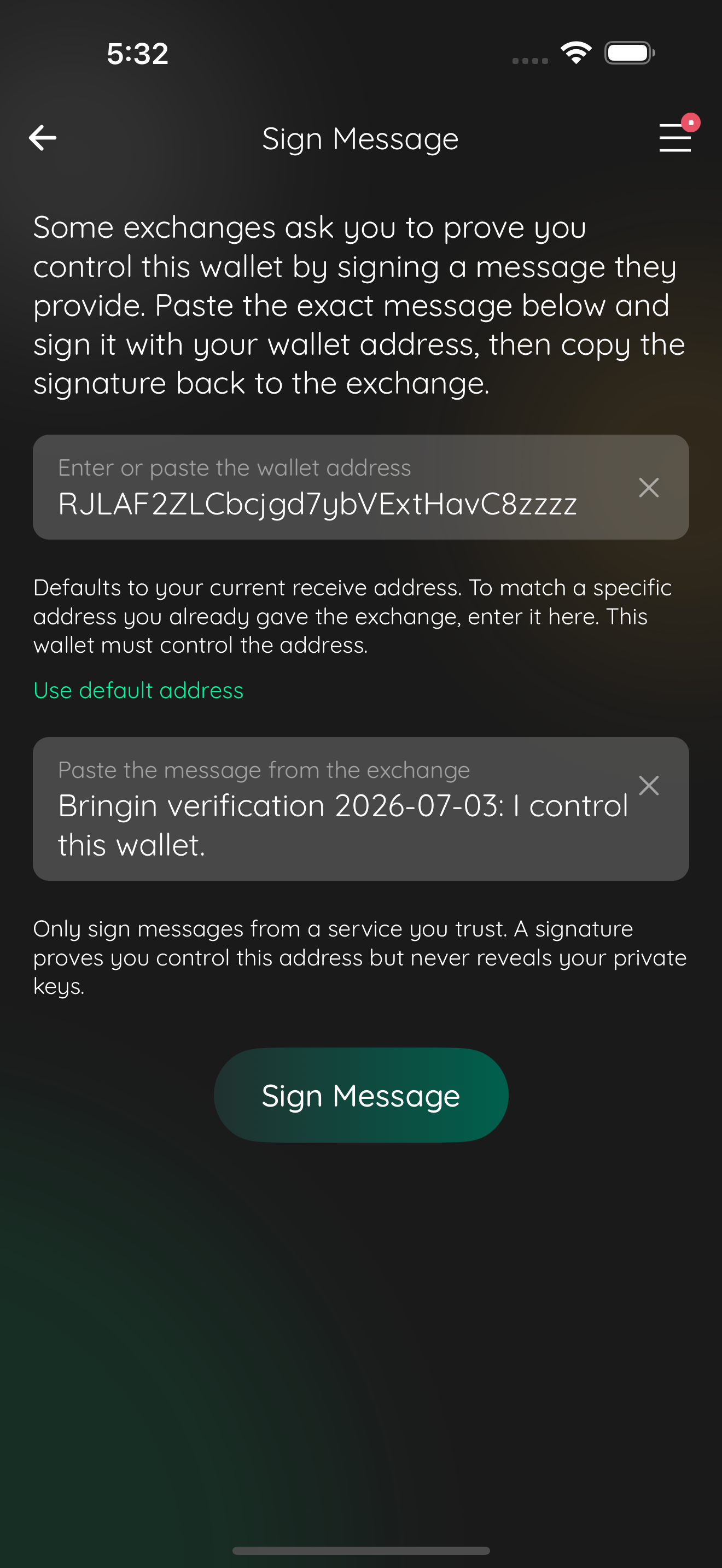
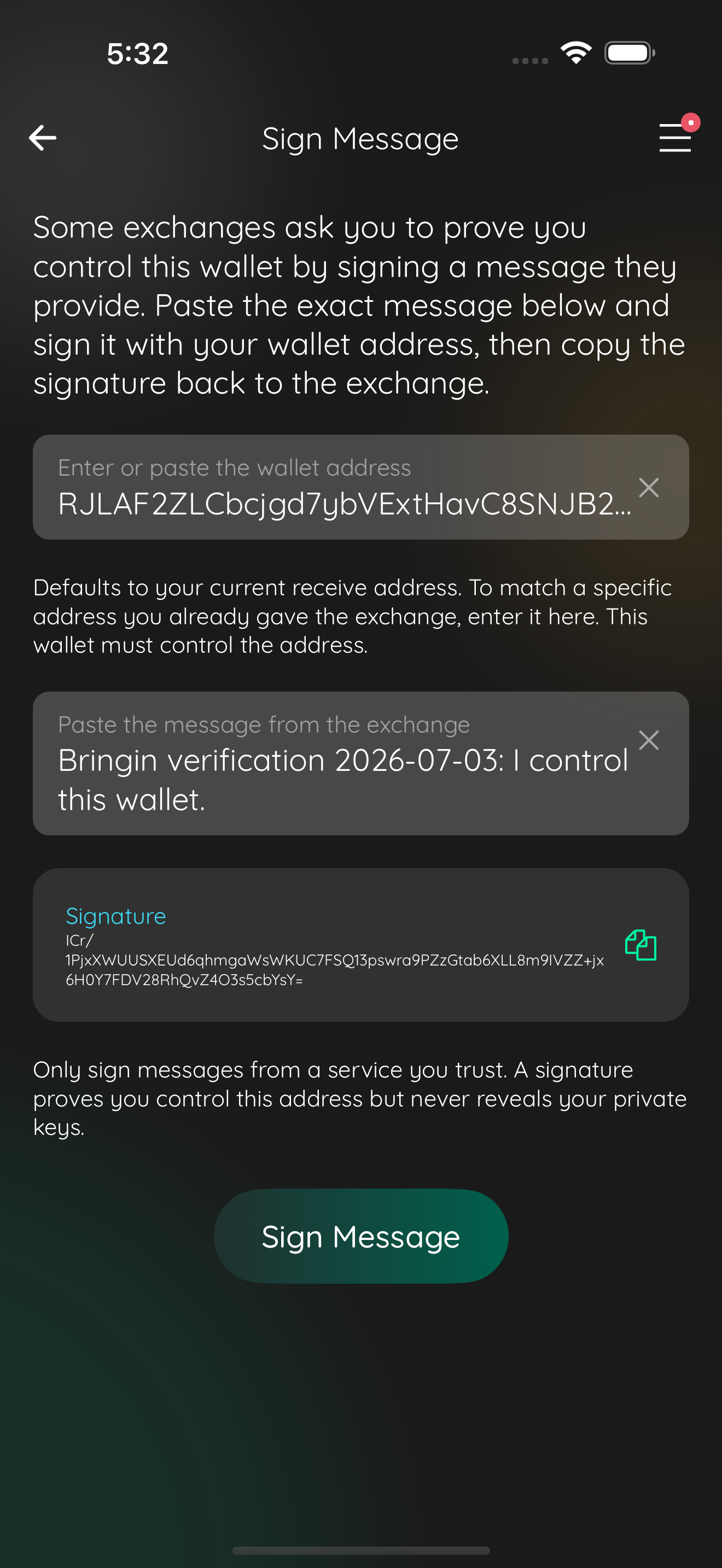
The Sign Message scene now shows the wallet's receive address in an editable
field instead of a read-only row. Exchanges typically ask a user to prove
control of the specific address they already provided (often a previously-used
one), so the user can replace the default with that address. The wallet must
control whichever address is entered; the plugin signs with the key derived
from that address's stored derivation path and rejects any address it does not
own, surfaced as a clear error. Editing the address clears any prior signature,
and a Use default address link restores the auto-detected receive address.
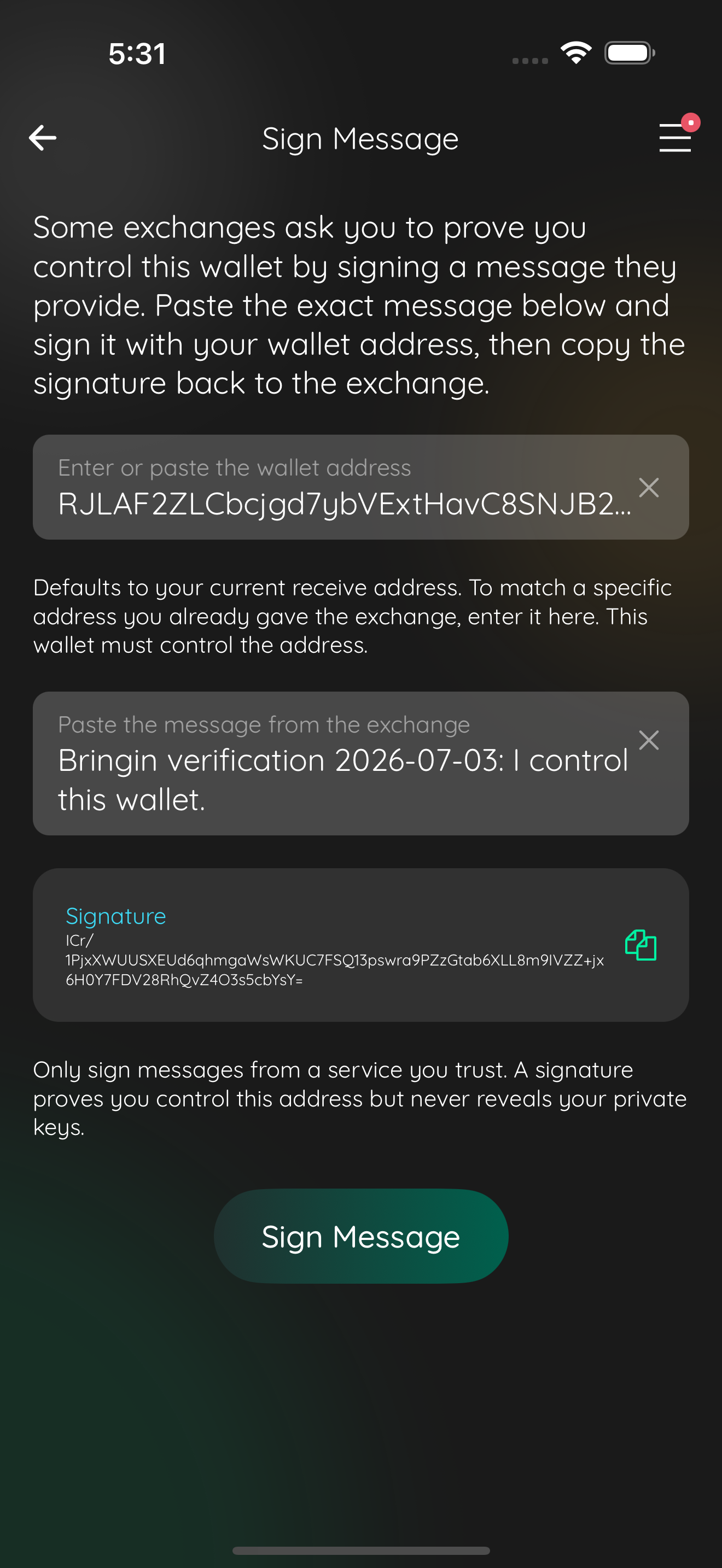
📸 Test evidence (followup: user-selectable signing address, Ravencoin UTXO wallet on iOS sim)agent proof 1209296431612665 01 signmsg default address
agent proof 1209296431612665 02 signature default address
agent proof 1209296431612665 03 address edited signature cleared
agent proof 1209296431612665 04 signature after reset
Captured by the agent's in-app test run (build-and-test). |
1 participant

CHANGELOG
Does this branch warrant an entry to the CHANGELOG?
Dependencies
none
Requirements
If you have made any visual changes to the GUI. Make sure you have:
Description
Adds an in-app Sign Message flow so a user can prove ownership of a self-hosted wallet by signing an exchange-provided message. This addresses EU Travel Rule / TFR withdrawal checks where CEXs/CASPs (Kraken, Coinbase, Bitvavo, Bitpanda, OKX, Bringin, NiceHash, etc.) require a signed message from the destination wallet instead of a manual ID/selfie proof.
BTC-first, per the task scope.
What it does
SignMessageScenethat shows the wallet's receive address (copyable, so the user can hand it to the exchange), a multiline message input, and a Sign Message button.wallet.signMessage(message, { otherParams: { publicAddress } })and displays the resulting base64 signature in a copyable card.Implementation notes
signMessageis used rather thansignBytesbecause for BitcoinsignBytesbase64-re-encodes the bytes before signing, which would produce a signature over the wrong data.signMessagesigns the literal UTF-8 message the exchange verifies (same pattern already used bybityProviderandEdgeProviderServer).wallet.getAddresses), because the UTXO plugin requires the address to be in its data layer.Files
SignMessageScene.tsx(new scene)routerTypes.tsx,Main.tsx(route + scene registration)WalletListMenuActions.tsx,WalletListMenuModal.tsx(menu entry, UTXO-scoped)en_US.ts(strings)Asana: https://app.asana.com/0/1215088146871429/1209296431612665
Testing
Verified end-to-end on the iOS simulator (edge-funds, My Bitcoin wallet): opened the wallet menu, tapped Sign Message, entered a message, and confirmed a valid base64 signature was produced and displayed. Proof screenshots attached below.
Note
Medium Risk
Signing invokes wallet private-key operations and users may sign untrusted messages, though keys are not exposed and address ownership is validated by the plugin.
Overview
Adds a Sign Message entry to the wallet list menu for Bitcoin-family (UTXO) wallets, so users can prove self-custody when a CEX asks for a signed withdrawal message (e.g. Travel Rule checks).
Choosing it opens a new
signMessagescreen: an editable signing address (prefilled from the wallet’s receive address, with Use default address), a multiline field for the exchange’s exact message, and a copyable signature afterwallet.signMessageruns with that address. Inputs lock while signing; changing address or message clears a stale signature. Copy includes a short trust/safety note and clearer errors when the wallet does not own the address.Navigation, menu actions, router types, and English strings are wired to match existing wallet-menu patterns.
Reviewed by Cursor Bugbot for commit 2a248af. Bugbot is set up for automated code reviews on this repo. Configure here.